How Do Basalt Rockwool Boards Absorb Sound?
Core Advantages of Taishi Acoustic Rockwool Boards
✅ Broad‑Frequency Sound Absorption
Effectively handles mid‑high‑frequency echo and low‑frequency vibration‑related noise. Optimised fibre structure improves noise‑reduction coefficient, helping designers meet regional acoustic standards for various building categories.
✅ A1 Non‑Combustible Fire Performance
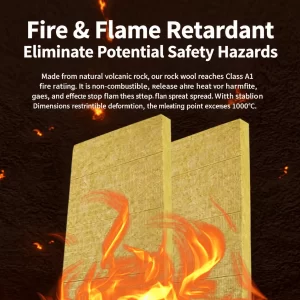
As fully inorganic basalt‑derived material, Taishi acoustic rockwool reaches A1 non‑combustible classification. It will not burn, propagate flame or release toxic smoke under high‑temperature conditions. Acoustic function will not compromise fire‑safety performance, a major advantage over organic acoustic alternatives.
✅ Hydrophobic & Long‑Term Stable Acoustic Output
Special hydrophobic treatment achieves ≥99 % water‑repellent rate. The material resists moisture penetration, avoids mildew and performance degradation. Its stable chemical composition brings long service life matching building lifespans. Acoustic indices will not obviously decay after decades of operation.
✅ Custom‑Engineered Specifications & Surface Facings
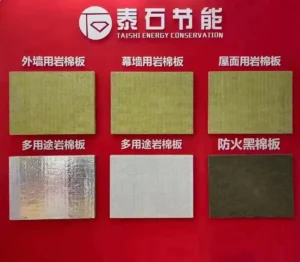
Besides adjustable density, thickness and overall dimensions, multiple surface‑facing options are available for different project needs. Bare rockwool maximises raw sound‑absorbing capacity. Aluminium foil facing adds vapour‑barrier and heat‑radiation‑shielding capability. Fibreglass‑cloth facing prevents loose‑fiber shedding for exposed installation locations. OEM and ODM services are offered for large‑scale contractor orders.
✅ Combined Thermal Insulation Benefit
Beyond noise control, rockwool boards maintain low thermal conductivity. While improving indoor acoustic comfort, they assist building energy‑saving goals and reduce overall heating‑and‑cooling loads. This dual‑value feature helps projects satisfy both acoustic and green‑building requirements.
✅ Easy‑to‑Process On‑Site Installation
Light‑weight rockwool panels can be freely cut according to site layouts. They fit neatly within partition frames, wall cavities and ceiling systems, lowering construction waste and shortening working cycles.
Typical Application Scenarios
- Commercial building partition and ceiling acoustic treatment
- Multi‑family residential separating wall cavity filling
- Office, conference space and public venue noise optimisation
- Cultural venues, educational and healthcare building acoustic assemblies
- Industrial building interior noise mitigation
- Composite panel core material for acoustic composite boards
Why Specify Taishi Acoustic Rockwool?
FAQ
Q1: Is higher density always better for sound‑absorbing rockwool?
A: Not exactly. Higher density improves low‑frequency noise damping, yet appropriate thickness and installation method also play decisive roles. Our technical team can recommend proper density‑thickness combinations according to your acoustic design targets.
Q2: Will different surface facings weaken sound‑absorbing effects?
A: Bare rockwool shows peak sound‑absorbing performance. Foil or fibreglass‑cloth facings bring extra functions such as vapour resistance and anti‑shedding, with only limited impact on overall acoustic results under most working conditions.
Q3: Can rockwool panels be used for exterior‑related acoustic assemblies?
A: Yes, with proper facing selection. Hydrophobic‑grade rockwool can be adopted for semi‑exposed building assemblies when matching protective construction details.