Introduction
Basalt rock wool board has become the preferred thermal insulation material for exterior wall systems worldwide, thanks to its Class A fire resistance, excellent thermal performance and long-term durability. However, many global contractors, importers and project buyers still face common pain points: mismatched density leading to project failure, wrong thickness causing energy waste, or non-compliant materials failing local building codes.
This 2026 updated guide covers everything you need to know about specifying basalt rock wool for exterior wall projects: performance requirements, density & thickness selection, common mistakes to avoid, regional compliance standards, and how to source cost-effective, export-qualified products.
1. Why Choose Basalt Rock Wool for Exterior Wall Insulation?
Compared with glass wool, EPS and XPS, basalt rock wool delivers unique advantages for exterior facade applications:
- Non-combustible fire safety: Class A1 fire rating, withstands temperatures over 1000°C, effectively stops flame spread in high-rise buildings
- Stable thermal performance: Low thermal conductivity (λ=0.034–0.040 W/m·K), reduces building heating and cooling energy loss by 30%–50%
- Structural compatibility: High tensile strength and compression resistance, adapts to thin-render facade systems and curtain wall cavities
- Weather & aging resistance: Resists humidity, freeze-thaw cycles and UV degradation, maintains performance for over 30 years
- Environmental compliance: Formaldehyde-free, recyclable, meets EU and global green building standards
2. Key Specifications for Exterior Wall Rock Wool Boards
2.1 Density Selection by Project Type
Density is the core parameter that determines mechanical strength and application scenarios. Choosing the right density balances safety and cost:
- 40–60 kg/m³: For interior backing and non-load-bearing wall cavities; not recommended for exposed exterior wall systems
- 80–100 kg/m³: Standard for low-rise and mid-rise exterior wall cavity filling, sandwich panel cores and conventional facade systems
- 100–140 kg/m³: Required for high-rise thin-render exterior walls, wind-load areas and ventilated facade systems
- Above 140 kg/m³: For heavy-duty facades, fire-stop bands, marine buildings and industrial exterior insulation
2.2 Thickness Calculation Reference
Thickness depends on local climate, energy codes and target U-value:
- Mild climate regions: 30–50 mm
- Temperate zones: 50–80 mm
- Cold regions (Russia, Central Asia, Northern Europe): 80–150 mm
- Extreme cold areas: 150–200 mm (multi-layer installation)
2.3 Critical Performance Indicators to Verify
- Thermal conductivity value (λ) at 10°C mean temperature
- Tensile strength perpendicular to faces
- Compressive strength
- Water repellency rate (should be ≥98% for exterior use)
- Fire rating certification
3. 5 Common Mistakes When Sourcing Exterior Wall Rock Wool
Avoid these costly errors that cause project rework and budget overruns:
- Pursuing ultra-high density blindly: Higher density does not equal better insulation. Over-specifying increases material cost and dead load without performance gains.
- Ignoring water repellency: Non-water-repellent rock wool absorbs moisture, loses thermal performance and causes facade cracking.
- Choosing wrong facing for the system: Aluminum foil facing is for vapor barrier; fiberglass cloth facing is for render systems. Mismatch leads to system failure.
- Ignoring local building codes: Europe requires CE marking, Russia and Central Asia require GOST certification, Middle East needs civil defense approval.
- Solely based on lowest price: Low-quality rock wool has poor fiber uniformity, high slag ball content and short service life.
4. Regional Specification Guide for Global Markets
Europe
- Comply with EN 13162 standard
- Common density: 100–120 kg/m³ for ETICS (External Thermal Insulation Composite System)
- Focus on fire reaction class A1 and thermal conductivity λ≤0.037 W/m·K
Russia & Central Asia
- GOST 9573-2015 compliance
- High density preference: 120–140 kg/m³ for extreme cold and strong wind
- Thickness commonly 100–150 mm for residential and commercial facades
Middle East & North Africa
- High temperature resistance and fire safety are top priorities
- 80–120 kg/m³ for exterior wall cladding systems
- Require low thermal conductivity for cooling energy saving
Southeast Asia
- Moisture-proof and mold resistance are critical
- 80–100 kg/m³ for commercial building exterior walls
- 30–50 mm thickness for tropical climate heat insulation
5. Custom Solutions for Special Projects
Standard sizes may not fit all project requirements. Reliable manufacturers should offer:
- Custom density from 40 kg/m³ to 200 kg/m³
- Custom thickness from 30 mm to 200 mm
- Optional facings: aluminum foil, fiberglass cloth, wire mesh
- Pre-cut dimensions for automated panel production lines
- Special packaging for sea freight and long-distance transportation
6. How Taishi Supports Global Buyers
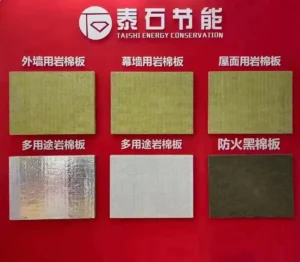
Taishi Energy Saving is a professional basalt rock wool manufacturer with over 10 years of export experience, supplying exterior wall insulation materials to 30+ countries.
- Full production line from melting to curing, stable bulk supply capacity
- Complete certification system: CE, ISO, GOST and more
- Free technical support: density recommendation, thickness calculation, system matching
- Flexible MOQ and export packaging: FOB, CIF, DDP trade terms available
- Sample provision and factory inspection welcome
If you are working on an exterior wall insulation project, or looking for a long-term rock wool supplier, send your project specifications to our engineering team. We will reply with a tailored solution and quotation within 24 hours.